
• blog
Blockhouse's Journey to a Full-Stack Quant Infrastructure Platform on Chain
in this article
Blockhouse is a platform that provides quantitative trading strategies and infrastructure in on-chain markets.
We have grown from $0 to $16M in deposits over the past six months, running capital for asset managers, funds of funds, and on-chain vaults that collectively represent over $5B in assets.
What looks like explosive overnight growth is really four years of work across two industries finally lining up. Each chapter taught us how institutional capital actually adopts technology and moves into a new market.
Where it Started
We (Pranav and Aadi) started the company as college roommates at NYU. Aadi dropped out during DeFi summer to build a crypto neobank. Pranav went to UBS to do quant research on structured equity products.
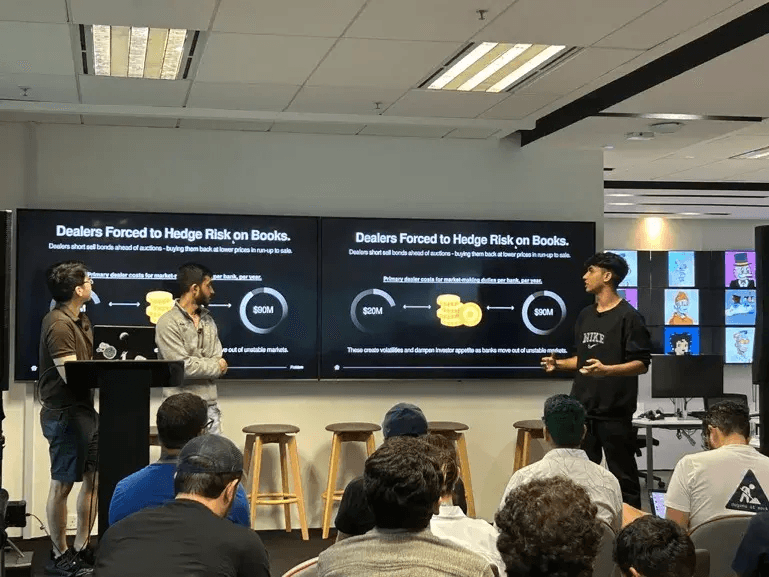
We both had an insane shared conviction that on-chain infrastructure would absorb real financial markets over the coming decade, so we left our jobs to pursue this mission full time.
Our first eighteen months were bootstrapped: spent at accelerators and hackathons, living in hacker houses, building MEV bots, and farming airdrops on the major crypto exchanges. We took hackathon wins at Launch House (MEV liquidation bot) and Delphi Labs x Injective Cosmos (hybrid DEX for real-world assets).
The Delphi win pulled us out of tinkering and into forming a real company. We built an early version of what Hyperliquid is today — a decentralized exchange for fixed income, equities, and crypto.
We joined Jump Crypto's Pit accelerator in Singapore and Chicago to test the thesis with one of the most sophisticated players in the space. Working alongside Jump made clear that institutions were adopting tokenized assets much more slowly than we had hoped. This was also late 2022, post-FTX, with institutional appetite for on-chain markets frozen.
The realistic path to liquidity required the largest banks to bring their assets on chain first, and a partner at Jump's scale could not anchor that market alone.
That observation pushed us toward a different bet: build technology around the rails institutions were already using, rather than wait for them to migrate to ours.
The TradFi Stint
The TradFi chapter started with consulting engagements at major banks and exchanges on fixed-income execution. They gave us proprietary trade data, and we utilized our in-house ML algos to estimate the cost of inefficiencies with their existing algos. We developed a keen understanding of where the institutional algos underperform, with granular data we couldn't have touched any other way.
But the constraint became clear within months. Building serious ML execution models requires a lot of data, and the firms we worked with would only share limited quantities of it with an external vendor. Publicly available data was nowhere near deep enough to fill the gap.
The bigger takeaway: large institutional partners are a double-edged sword. They bring credibility, data, and distribution alongside sales cycles slow enough to outlast a startup.
Toward the end of that period, two signals showed up at once. Crypto was attracting serious institutional allocations again, and the data we'd spent years fighting for in TradFi was openly available on crypto venues. Both signs pointed back to crypto, our inception.
How we Integrated the Whole Stack
When we came back to crypto in early 2025, we were not starting from scratch. The equities execution algos and research gave us a starting point most teams in crypto do not have. We ported the stack to crypto and layered arbitrage strategies on top of it to complete our own non-custodial quant strategy.
The first strategy on that stack is a systematic basis arbitrage strategy across seven major CEX and DEX venues. We launched with our first institutional client in September 2025 and have grown to roughly $16M of AUM since. Strategies for tokenized stocks and commodities roll out this quarter, with prediction markets coming next (both on the same tech stack).
The long term plan is to productize the algorithms, market data infrastructure, and execution research we run internally as SaaS offerings. Products will be released in three sequential phases across all asset classes, with day-one distribution and volume from existing clients.
Phase 1 — Tokenized vaults. Wrapping our strategies into on-chain products anyone can deposit into, anchored by a yield-bearing stablecoin similar in structure to Ethena's USDe.
Phase 2 — Prime brokerage. Exposing our internal stack (custody, financing, execution, cross-venue margining, reporting) to external clients.
Phase 3 — The exchange. A matching engine for tokenized assets. It launches with day-one volume from prime brokerage clients and vault depositors already routed through us. The stablecoin becomes the preferred collateral asset traders post against every market — earning yield while it sits as margin, deepening order books, and feeding flow back into the strategies that back it. That's the loop Bybit ran with USDe.
Each phase compounds the next, and owning the full stack means we capture spread, custody, financing, and matching engine economics on every dollar of institutional capital.
The shape of Blockhouse today is a direct product of every chapter that came before. They were the conditions under which we could build a firm institutional capital would actually want to deploy through, once the timing finally aligned.
None were detours from the original thesis.
The generation defining work is still ahead of us, but we are confident that this is the right team to do it.